Is it illegal to get a tattoo in South Korea?

Q: I am interested in getting a tattoo. However, I was recently told that it is illegal to get a tattoo in Korea. Is that true?

A: Getting a tattoo in Korea is not illegal. So if you want one, you can get one.

But here’s the catch.

It is illegal to get a tattoo from an artist who does not have a medical license.

You may wonder… “will I get charged for getting a tattoo from an artist who is not a licensed medical professional?”

My answer to that is: No, I do not think you will get charged.

Instead, the tattoo artist who does not have a medical license will get fined. 

Tattoos are no longer taboo in Korea. And many tattoo artists have been voicing their opinions to help change this law.

But earlier this year, the Constitutional Court decided to keep the original law in place.

They insisted that tattooing should continue to be considered a medical procedure that only a doctor should perform.

So if a tattoo artist without a medical license gives you a tattoo, he or she can face up to two years in prison or be required to pay 10 million won in fines.

Carparazzi

Q: It’s a little embarrassing, but I got a letter from the police. Here’s a thing. I don’t remember when it was exactly, but someone took a picture of me changing the lane without a blinker. And obviously that person reported it, and the police sent me a letter of “교통 법규 위반 사실 확인 요청서”. Now, what am I supposed to do?

A: You must have been surprised. It’s no fun to receive a formal letter from the police.

Let me translate교통 법규 위반 사실 확인 요청서.

교통 traffic / 법규 law / 위반 violation / 사실 fact / 확인 confirmation / 요청서 request

= Traffic Law Violation Fact Confirmation Request

These days everybody has a phone. They are actually called “Car-parazzi”.

So every small mistake that you make on the road without even realizing can be caught on the picture.

Like… Let’s suppose that you smoked in your car, and the butt from the cigarette littered the road… This can be caught and recorded.

Or Let’s suppose that you were way too fast and furious on the road… then yes, that can leave a negative mark on your record…

Or…. let’s suppose that there was a heavy traffic to a certain exit of a high way.

You couldn’t wait long, and let’s suppose that you cut the line, changing the lane at a very last minute, then one can capture that moment.

Of course, you shouldn’t have done it in the first place.

But things happened, and you got this letter from the police.

Then what should you do if you receive “교통 법규 위반 사실 확인 요청서”?

If you take a close look at the letter, it says “면제 사유가 있을 경우 담당자에게 문의하시기 바랍니다” meaning “if there’s a reason for exemption, please contact the person in charge.”

So please make a phone call to the police station, and explain your reasoning behind your action.

If you cannot defend yourself, you are required to pay the fine.

Part-time work and your rights

Q: I have been working a part time. I soon plan to quit. But can I have a retirement fund (퇴직금)?

A: As long as you worked over a year, yes.

By Korean law, employees are entitled to receive retirement funds which is equal to one month’s salary for each year of employment, if they have worked for one year or more and they have worked for more than 15 hours per week… or more than 60 hours per month.

Your retirement fund is supposed to be given to you within two weeks of your last day of your work.

But if you worked less than 12 months, you are not eligible for a retirement fund.

Paying the maintenance fee while you are on vacation

Q: I am an expat living in Busan. I haven’t been able to visit my family back home, but this winter, I am going to make a short visit, which I am very excited about. My question is: Can I pay the maintenance fee one month early? In my apartment, I am supposed to pay maintenance fee between the 25th and the last day of the month. But I am away during that week. If I am late, I have to pay a little bit of penalty. So I wonder if I can pay early.

A: It probably differs from apartment to apartment, so you better check with your 관리사무소 (maintenance office).

But when I checked with the 관리사무소 of my apartment, the staff there told me that I couldn’t, because monthly electricity bills and water bills are all included in the maintenance fee.

What they suggested was that if you let your maintenance fee be paid automatically with your credit card, it can be paid on time.

If you want to do this, you should sign up for this service to your credit card company.

What can you do about your noisy neighbors?

Q: I am having some problems with jumping children upstairs from me. I have no idea why they would allow their children to do this. Despite asking for help from the landlord, they don’t stop. It’s a new apartment building, and I love this place, but I don’t know what to do with them. I am thinking of writing a kind note or something. What else can I do?

A: You live in an apartment. I live in an apartment. Most people in Korea live in an apartment. I am pretty sure that a lot of Koreans out there are experiencing the same thing.

Before we get started, here’s a survey.

According to Korea Environment Corporation (한국 환경 공단), complaints submitted to the Floor Noise Management Center (aka층간소음 이웃사이 센터) have more than doubled last year during the COVID 19 situation. (That explains a lot!)

People stayed home for longer hours than ever.

Kids were home-schooled.

So many apartments have placed fliers and leaflets on their bulletin board or on their elevator saying “discipline your children”, “walk gently”, or “Do not use a treadmill late at night”.

Still, that doesn’t stop people from being noisy.

So, we have guidelines for common residential buildings noise.

It’s called 공동주택 층간소음 범위와 기준에 관한 규칙.

Rules vary a little, depending on the time and the size of the building.

The permitted range of noise level is around 40-50 decibels.

When you hear 40 decibels, you can’t probably tell how noisy it means.

A typical conversation is around 40-50 decibels.

If your kids are running here and there, decibel goes up around 60 decibels.

So, that means, daily noise under the guideline is within the reasonable range of noise level.

If the sound level is too high, what should you do? Can you visit upstairs?

It’s legal for you to visit your neighbor to complain about this problem.

You can visit the family upstairs. You can knock on their door or ring a bell.

Or if you think you are the one who’s making the noise, you can visit people downstairs to apologize in advanced, too.

But if you bang on the door, yell in the middle of the night to make a complaint, it can be problematic.

There’s something that you should be aware of.

In Korea, there’s a crime called “주거침입죄”. – trespassing.

Banging on the door or yelling in the middle of the night can also be defined as “주거침입죄”. (because the hall way is also considered as their property)

Don’t try to enter your neighbor’s home against their will.

You should never their passcode to enter their residence.

Even if you tried to talk to your neighbor about this problem, but if you don’t see any improvement… what I suggest is that you call the Floor Noise Management Center. Its number is 1661 2642.

The first thing they’ll do is send a letter to your neighbor.

They ask whether he or she wishes to participate consultation.

If that person says yes, they arrange the first meeting.

If they refuse or if they don’t answer, the center sends the second letter.

They will arrange the consultation and they will help decide what to do next.

And in the worst case scenario, if the level of noise reaches beyond the tolerable level, you can file a lawsuit.

You can ask for compensation if you have to move out or if you have to visit a doctor.

Bringing your pets to South Korea

Q: I am relatively in the early stages of looking into teaching in Korea, probably beginning next year. Only one big problem: I have a dog. And I would love to bring him with me. I know this process will probably be expensive and lengthy. Can you suggest any recruiters who work with those who bring pets to Korea?

A: Just a heads-up. I don’t know which country you are coming from, but a lot of airlines have changed their pet policy during Covid.

So before you talk about it with your recruiters, I want you to check that first.

I don’t think that it will be difficult to bring your pet to Korea, but there are things you need to prepare for.

You have to have your documents and vaccinations ready before you depart.

If you don’t have everything, your dog can be held in quarantine.

It’s something you don’t want , because it takes time to get them out, plus unnecessary expenses occur.

And.. Some landlords here in Korea are picky about their tenants having a pet.

But I read somewhere that many schools and hagwons don’t mind teachers about coming with their pets.

There are a few groups on social media where you can find tons of information about it. So I suggest that, too. Anyways, hope you make it soon!

How to celebrate Teachers’ Day

Q: Hi. I should have asked earlier, though. Tomorrow (May 15) is Teacher’s Day. My daughter is in elementary school. I don’t know what I should get for teachers for Teacher’s Day. I would appreciate if you could give some tips.

A: You are not the only mother who’s wondering what to get for teachers on Teacher’s Day. I am there, too.

I am not sure how long this person has been in Korea, though.

In 2016, the anti-graft law aka Kim Youngran Law was implemented.

According to this law, journalists, civil servants, teachers in public schools are not allowed to accept gifts worth more than 50,000 won. ($50)

Those who break the law can actually face a jail sentence of up to three years or a fine of up to 30 million won.

But at some point, the law is even stricter for teachers.

If you visit the teacher who taught you in the previous years, and if you purchased a present worth under 50,000 won, it would be acceptable.

But if you give a present to the teacher who teaches you, that’s considered a big no-no, because the teacher who teaches either you or your children is responsible to evaluate. Then, the gift you give is considered ‘a bribe’.

So, my suggestion is write a letter.

Say thank you and let them know how thankful you are.

Voice Phishing Scams

Q: Hello, I am an expat living here in Busan. I recently had someone try a voice phishing attack on me in Korea. What was amazing was when I told them that I could not speak Korean very well, they called back a few minutes later with a fluent English speaker. They had a strange story about my passport being found in the Incheon International Airport. Then they told me to follow their instructions to get my passport back and I almost fell for it. I was too busy at that moment to continue the

conversation, so I kindly asked them to call me back later. Luckily, I found my passport before they were able to call me back. Do you think I should report this to the police?

A: It sounds like you had been scammed. Voice phishing has made headlines here in Korea for a quite a long time now.

Whenever I heard news about victims of voice phishing calls, I assumed that they were either elderly or were not being careful….

But anyone can be a victim.

This happened to me a few months ago.

I do not normally take naps, but that day I took a nap, and I was awakened by a phone call.

The caller said that I had ordered something from overseas and had paid twice for the item with my credit card. He told me to give him my information to receive a refund or to cancel the payment.

He almost got me, because it was true that I had bought something online earlier that month.

Luckily, I was still a bit groggy from my nap, so I had difficulty following his instructions.

When I didn’t understand properly, he sounded annoyed.

Then, instinctively, I could tell that something was not right.

So I said, “Okay, sir, would you mind if I call you back in a few minutes?” And I asked for his name and his office number.

After, I checked with my credit card statement, and it had not been charged twice.

I was so close to being trapped!

These days, voice phishing scammers are so good… .

In the past, voice phishing was more like…

one of your family members is being kidnapped and you have to pay a certain amount of money to have them released.

But times have changed.

For example, you may receive a text message saying, “this is a message from a Gu-office. Click the link to see if you are eligible for a COVID relief fund.”

But if you click the link, it will not lead to the website of the Gu office, but instead

automatically charge your bank account. That’s just crazy.

The crime has evolved so much that just about anyone can become a victim.

It’s good that this person didn’t send any money to get his or her passport back, but… just be careful.

If the money has been already sent, you must visit your bank as soon as possible.

That way, they can suspend (freeze) that bank account.

Or call 1322. It’s the number of 금융 감독원, the Financial Supervisory Service.

Since you personally gave no information to the caller it is not necessary to inform the police.

But please remember:

Banks do not call to offer you a lower interest.

If someone calls you and asks for your personal information, a picture of your ID card, or your bank account number, chances are that you are being scammed.

If someone sends you a text message with a link, do not open it.

Names that cannot be used in passports

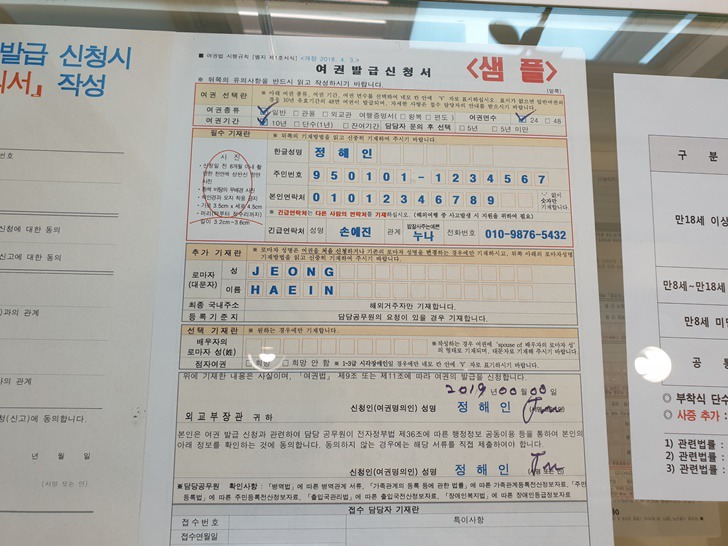
Q: My daughter is now four years old. My husband and I used to travel a lot, but we haven’t been able to since COVID. We want to get our daughter a passport soon. Her name is ‘비’, meaning “Rain”. Can I put ‘Rain’ instead of ‘비 Bee’ on her passport?

A: I am afraid you can’t.

I had a very similar issue with my daughter’s name which is ‘가을’ meaning Autumn.

She was born before the pandemic and we got her a passport.

When I applied for her passport, I wanted to put ‘Autumn’, instead of ‘가을 spelling G-A-E-U-L’.

But I was told that I had to spell it on paper the way her name is pronounced.

So in your case, I don’t think you can use the name ‘Rain’ on her passport.

Can a foreigner retire in Busan?

Q: I have been working and living in Korea and will be looking to retire within the next five years (If I am lucky, I will be able to work a little longer than that). I was wondering if I could stay in Korea even after I retire. Thank you.

A: Visas are complicated.

Technically speaking, South Korea doesn’t offer retirement visas to foreign citizens, unfortunately.

The good thing is it seems like you have more than five years to prepare for your retirment.

So please consider these options:

If you are currently single, you could possibly find a partner who is Korean or an F-5 visa holder. I you marry this person, then your visa status is solved.

Or if you have Korean blood, say you are Korean-American, Korean-Canadian, etc, you are immediately eligible for a permanent residency.

Or if you own an apartment in Korea valued over $300,000, that would aid you in getting a visa.

Or if you invest a large sum of money such as $500,000 or more, you can become a perminant resident.

Or if you speak Korean really well and have published material as a scholar, that would also benefit you.

I think Busan Global Center is in the position for providing you with better information regarding Visa issues.

If you are interested, please contact the Busan Global Center where a consultant can help you free of charge or visit www.bfic.kr / or call 1577-7716.