Cho Yongpil’s “Return to Busan Port”

Have you heard of the song, “Return to Busan Port” (“돌아와요 부산항에)? This song was sung by Cho Yongpil back in the 1970s.

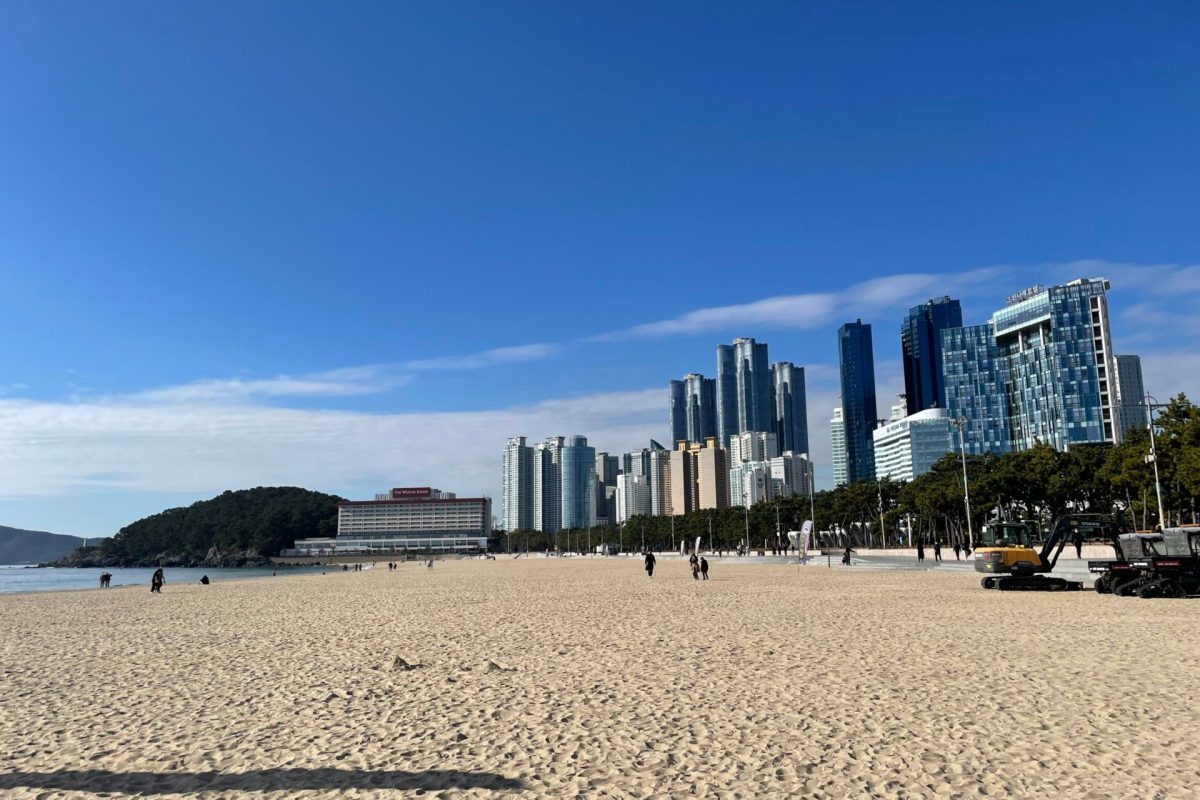
Now it is recognized as one of Busan’s most representative songs, so when you have the chance to walk along the Haeundae Beach, give it a listen!
There is even a sculpture near the beach that has the lyrics written on it! Listening to the lyrics can help you understand some of Korea’s modern history. So, here is the song!

꽃피는 동백섬에 봄이 왔건만
형제떠난 부산항에 갈매기만 슬피우네
오륙도 돌아가는 연락선마다
목메어 불러봐도 대답없는 내 형제여
돌아와요 부산항에 그리운 내 형제여

The spring has come on the Dongbaek Island where the flowers are blooming.

But seagulls whose brothers have gone are just here to cry at the Busan Port.

No matter how hard I call you, my bro, you can’t answer.

Return to Busan Port.

In the 1960s, many Koreans left Korea to search for better job opportunities. Around 8,000 Korean miners and more than 10,000 nurses went to Germany in hopes of finding work. Many were able to make enough money to provide for their families back in Korea. The money they earned was essential in supporting their loved ones in such a poverty-stricken country.

The movie, 국제시장 or Ode to my Father may help you understand that part of Korean history!

Those who left Korea were not guaranteed to ever see their families again. It became easy for many of them to feel lonely and homesick. With no cure for homesickness, songs like “돌아와요 부산항에” or “Return to Busan” helped ease their sorrow.

Did You Know Trams Used to Run in Busan?

Is there a tram in your city? Here in Busan, we don’t use them. 

The only time that my family and I rode a tram was when we traveled to Vienna and Prague. I loved them. The trams ran pretty much everywhere, making it a fun and convenient way to get around the city.

Many of you might not know that there used to be a tram running through the heart of Busan, because there are no traces of it left in the city today. But let me tell you: Busan was one of three cities in Korea that had trams: Busan, Seoul and Pyeongyang.

The first tram line opened in 1915 here in Busan. The majority of people who traveled by tram were Japanese. In the early 1900s, many Japanese lived near the Choryang Weagwan area in Busan.

They loved to visit Dongrae area to enjoy the spa. So, to make their journey to Dongrae easier, they built tram lines between Jin-gu and Dongrae. It took about 20 minutes by tram to get to Dongrae from Jingu, cutting down on travel time.

But Koreans did not like trams…

There were a lot of misconceptions about trams, because they used electrical power. Koreans experienced a lengthy drought in the early 1900s. Right now it doesn’t make sense, but people back then believed that the overhead wires that powered the trams absorbed moisture and prevented rain showers.

Some incidents have occurred onboard a tram. In 1933, a man in his 70s was taking a mini trip to Busan from Yangsan. He was so startled after seeing a tram for the first time, that he jumped right onto the track. Although he was quite injured, luckily he didn’t lose his life.

In May of 1934, a baby was born on a tram. The mother, who was in her 20s was visiting her family from Ulsan. While taking the tram to the hospital, she gave birth to a baby girl.

Trams back then ran on two different routes; one was from Gudeok stadium to Yeongdo and the other went from Gudeok Stadium to Oncheonjang.

The trams moved so slowly that passengers were able to simply hop off at any point, whether they were at one of the 11 stations or not.

As time went by, Koreans changed the way they felt about trams.

In 1910 there were about 19 trams, but by 1957 there were 73.

The demand for trams continued to increase as they received more frequent passengers. By 1966 there were nearly 150,000 people who relied on the trams for transportation.

That year, there was about 1.4 million people living in Busan, which means that more the 10 percent of Busan’s population traveled via trams.

Trams, however, stopped operating on May 19th, 1968, due to the destruction caused by the Korean War. Salvageable tram cars were sold for cash.

However, if you go to Bumin Campus at Donga University in Busan, you will be able to see one of Busan’s trams that was made in Atlanta.

If you visit between 1 and 2 pm, you can go inside of the car.

From Fusan to Pusan to Busan

From Fusan to Pusan to Busan…

Featuring the Story of the First Korean Olympic Gold Medalist

Any idea who the first Korean Olympic gold medalist was? Well, Son Gijeong was the first! He won the gold medal in the marathon category at the 1936 Berlin Olympics.

However, he had to be a member of the Japanese delegation, because Korea was still under Japanese rule. Because of this, he was not allowed to run with the Korean flag or “Taeguki” on his chest.

He was not even allowed to use his Korean name and instead had to compete under the Japanese name, Son Kitei. Son Kitei was how the Japanese pronounced his name in Chinese characters since most Korean names could be written in “Hanja” or Chinese characters.

There is a 손기정 기념관 or Son Gijeong Memorial Center in Seoul that has 손기정 travel ticket from Berlin from Tokyo on display.

If you look closely at the ticket, you may notice that Son didn’t fly directly to Berlin. Instead, he used many different kinds of ground transportation. First, he took a ferry from Tokyo to Busan, then a train and a truck to Harbin, Warsaw, and finally one to Germany.

It took him a total of 15 days to travel to Berlin! Even though he was jetlagged, he still managed to bring home a gold metal.

Also, you may have noticed that his travel ticket spelled Busan with an F. This is because the Japanese used to spell Busan as Fusan when they occupied Korea.

After Korea gained its independence, Busan was spelled many different ways, but mainly with either an F or a P as the first letter.

Many people demanded that the city choose an official spelling before the Korea/ Japan World Cup in 2002. So, in 2000 Busan was officially named Busan.

Looking Back at the 1st BIFF 1996 [Featuring Five Interesting Facts]

We are only one week away from celebrating the 27th Busan International Film Festival (BIFF). Numerous movie directors, actors, actresses and movie fans will visit Busan during this time, making the city extra crowded. So, let me take you back to 1996 when the first Busan International Film Festival took place.

1. The first film festival was held on Friday, September 13, 1996, at the Suyeong Bay Yachting Center. To kick off the event, well known Korean actors and actresses including Shin Seongil, Kang Suyeon and Shim Eunha walked the red carpet while the Busan New Philharmonic Orchestra played “Return to Busan Port.” Since then, the festival has been held in October.

2. The festival’s opening night film was a 1996 British drama called Secret and Lies. This popular film, directed by Mike Leigh, starred Marianne Jean Baptiste and Brenda Blethyn. Blethyn was one of the few non-Korean movie stars who attended the first Busan international Film Festival.

3. Even though the film festival only showed 169 films from 30 countries, Busan was flooded with over 180,000 movie fans. People gravitated to the festival because it was not easy to watch foreign films in languages other than English at that time.

4. In the 1990s, restaurants and bars were not allowed to stay open past midnight in Busan. Most of the movie theaters in Busan were in Nampo-dong, which meant that people would often sit on newspapers and drink after a late film instead of getting to eat in a restaurant.

5. The Busan International Film Festival (aka BIFF) used to be called PIFF. Not until 2011 did movie organizers and city officials finally decided to change it to BIFF.

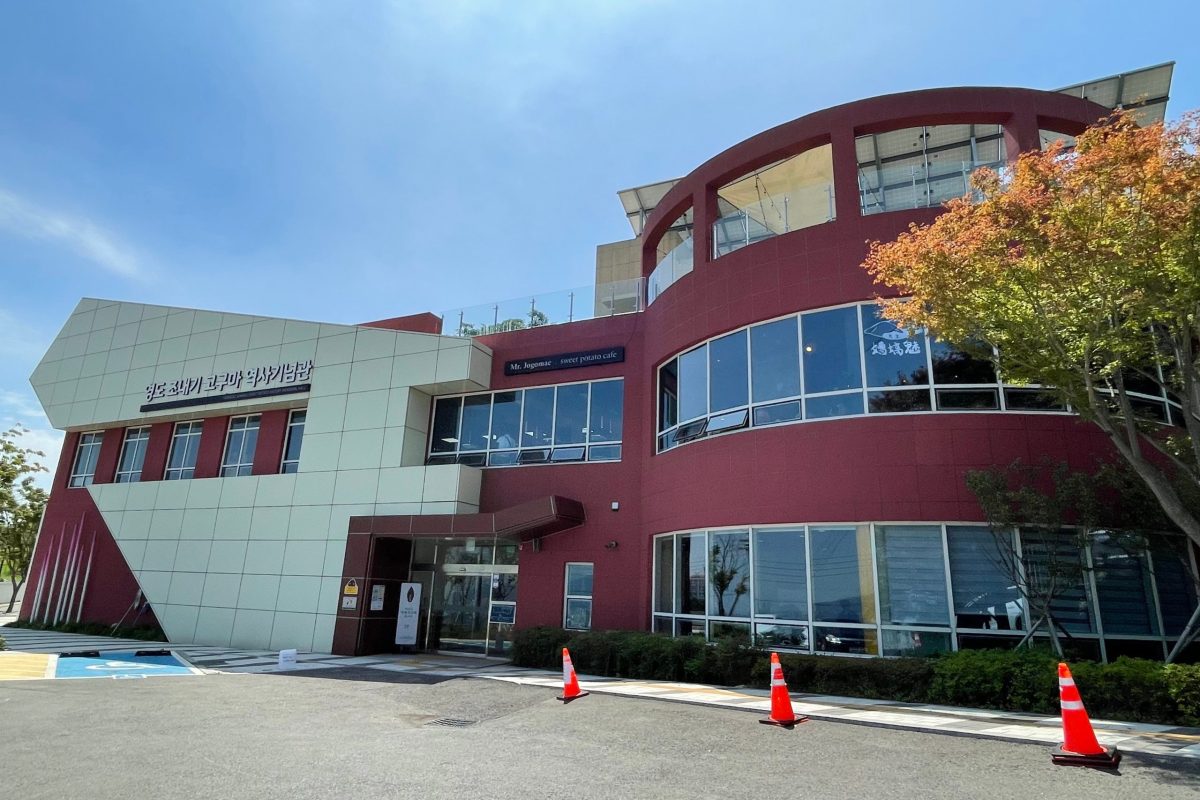
Yeongdo Jonaegi Sweet Potato History Museum

It’s September already, and soon it will be starting to feel like autumn. There is a Korean expression that describes the season of autumn.

It is “Chun-go-ma-bi (천고마비)”. People say, “it is the time of Chun-go-ma-bi.” Have you heard this expression before, and can you guess its meaning?

Chun – Sky

Go – High

Ma – Horse

Bi – Fat

It literally translates to, “the sky is high while the horse gains weight.” Simply put, it means “autumn is a good season to go outside and eat!” Since autumn is the season of harvesting goods, there is a lot of good food to enjoy.

By the way, did you know that there is a sweet potato history museum in Busan? Well, there is! So let me tell you about the history of how sweet potatoes came to Busan.

Yeongdo Jonaegi Sweet Potato History Museum

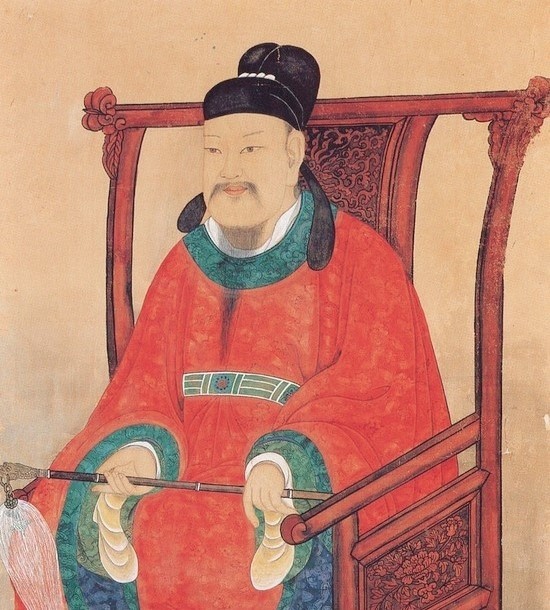
It goes back to 1764 during the reign of King Yeongjo (영조) of the Korean Joseon Dynasty.

King Yeongjo

Joseon Tongsinsas were then diplomatic envoys sent to Japan at the request of Japanese officials.

This group was made up of diplomats, scholars, artists, and doctors. The group toured Japan – from Tsuhima Island all the way to Edo, which is today’s Tokyo. According to records, one group of Joseon Tongsinsa consisted of around 450 people, and they were all well-liked by their neighbors.

They were like the rock start we have today as they set international trends. Because of them, hundreds of horses, art pieces, stationery, books, and agriculture products were brought to Japan. In return, they we able to bring sweet potatoes from Japan.

Joseon Tongsinsa

During the 40th year of King Yeongjo’s rule, King Yeongjo sent a diplomatic mission to Japan. Jo Eum (조엄) was the chief envoy over the mission. According to reports, 477 people traveled with him. Jo eum soon found sweet potatoes in the northern parts of the Tsushima Island. He loved the taste of them and thought that if Joseon people could grow sweet potatoes in their backyard, they would not have to worry about having enough food to eat.

So, he had one of his officials named Lee Unghyuk (이응혁) carry a few sweet potato slips back with him. (Did you know that sweet potatoes do not have seeds like most other vegetables. Instead, they produce something called a slip, which can be planted like a seed!) However, Lee failed to keep the slips from rotting on his way back home.

Meanwhile, the Dongrae (동래) city official, Kang Pilly (강필리) found out that Jo had discovered

sweet potatoes in the northern parts of the Tsushima Island and that the sweet potato slips carried by Lee could not be replanted. He could not wait to grow and enjoy his own sweet potatoes. He had people go and retrieve more slips from Tsushima Island. This time the slips made it back to Busan without any issues.

The first sweet potatoes were planted in the Yeongdo-gu district of Busan in the spring of 1765 in the Naegi area. To remember Jo’s effort in bringing sweet potatoes to Korea, Kang decided to put his last name “Jo” before “Naegi.” That is how the sweet potatoes were named “Jonaegi sweet potatoes.” People believed that sweet potatoes grown in that area tasted the best. That’s why Jonaegi sweet potatoes are still the most popular sweet potatoes in supermarkets in Korea.

Meanwhile, the Dongrae city official named Kang spent a lot of time researching sweet potatoes.

He even published his research in a book. The title of the book was “Gamjeobo (감저보).” Sweet potatoes are now called Goguma (고구마), but back then, they used to be called Gamjeo (감저). Interestingly, potatoes are called Gamja in Korean. So, when sweet potatoes were first brought to Korea, people probably named the sweet potatoes Gamjeo by changing one vowel in the word Gamja.

Anyways, thanks to Kang’s book, people from different regions have started to grow sweet potatoes.

So check out the Jonaegi Sweet Potato History Museum located in Yeongdo to find more information. There is also a café that serves sweet potato inspired drinks and baked goods. My favorite is the homemade soy milk served in a kettle! Twice a month, a cooking class is held for kids to join.

Address: Cherry Blossom Road 75, Yeongdo-gu, Busan

Hours: 10 am to 6 pm (Closed on Mondays and national holidays)

Admission: Free

How to get there: Take bus 101 at Busan Train Station. Get off at Yeongdo Bridge. Transfer to village bus number 7 at 청학 [Cheonghak] gas station and then get off at 동조 Dongjo Regency. (You will climb one of the steepest hills on your way to the museum! )

The History of Jeombachi Alley

Today, I would like to tell you about a small town in Busan that used to be bustling with fortune tellers.

Btw, have you ever been to see a fortune teller? My friends and I visited one once in our early 20s after graduating from university and starting our first jobs.

You know… everyone worries about something while in their 20s… My friends and I were no exception. We were worried about our futures and felt that we needed guidance on some of the more important choices we would have to make.

So, another one of my friends told us about an older lady who was the best fortune-teller in Busan.

More than ten years have passed since my last visit and believe it or not, most of her predictions were fairly accurate. The fortune-teller said that I would have many chances to speak in front of large crowds, which is true now that I have worked for a radio station. I don’t know if everything happened by coincidence but visiting a fortune teller was not as bad as I thought it would be.

Let me get back on topic…

There used be a town in Busan filled with fortune tellers.

The town was located under the Yeongdo Bridge and used to be called “점바치 골목 or Jeombachi Alley.”

Any ideas what Jeombachi (점바치) means?

Korean for “a fortune teller” is 점쟁이 [Jeom-jang-ee]. People in Busan speak with a Busan dialect. Speaking with a Busan dialect, “점쟁이” was “Jeombachi”. (But personally, I’ve never heard anybody say “Jeombachi”.)

Do you know what the Yeongdo Bridge meant to Koreans during the Korean War?

Busan was one of the only cities not captured during the Korean War, so millions of refugees gathered here for safety. Back then, the Yeongdo Bridge was a very important place, because it was where many refugees promised to reunite with their loved ones.

So, why do you think people visit fortune tellers?

People visit fortune tellers for many reasons, but most commonly because they need guidance through a dilemma.

After the Korean War ended, people struggled to survive. They were faced with the uncertainty of the future. So they visited Jeombachi Alley.

The fortune tellers there provided them with a peace of mind. Then, by having their futures predicted via their star, palm, Saju (사주), or by cards, it gave them a sense of security.

Back in the 1950s and 1960s, there were more than 50 fortune teller shops in “Jeombachi Alley”.

When refugees visited a fortune teller, they asked things like, “where and when can I find my sister, Mija?” or “Should I continue living in Busan?”

But now, Jeombachi Alley doesn’t exist anymore.

So why are there very few fortune tellers left?

Some fortune tellers have died of old age or have been asked to stop their practice.

Due to a redevelopment plan, the remaining fortune tellers, who had spent 40 to 50 years of their lives under the bridge, were asked to move out. It was in 2013 when the last fortune teller left the area.

Instead, new cafes, bakeries and restaurants have been built in their absence.

But many people raised their voices in support of Jeombachi Alley, because it’s intangible cultural heritage.

The City of Busan planned to move “Jeombachi Alley” to Eurari (유라리) Square, a small square located next to the Lotte Department Store in Gwangbok-dong.

So, in 2016, the government called upon a few fortune tellers who were interested in starting a fortune-telling business in Eurari Square, but some vendors who already worked at the square protested these plans. They did not want to share the space with the fortune tellers.

In the end, Jeombachi Alley simply disappeared.

The Song We Sing at Baseball Games

Are you a fan of baseball? Honestly, I do not know that much about baseball, but I am still a Lotte Giants fan.

There is a quote that says, “you don’t choose your family. They choose you.”

It is like how you can’t choose who your family is, you can’t choose which baseball team to cheer for. If you were born in Busan, you are supposed to cheer for the Lotte Giants. That’s that.

Let me tell you a little bit about the team song that the Busan fans chant at each game.

It’s called ‘Busan Seagull’.

Many of these songs have lyrics that inspire victory and excitement such as the verses “we are the champions” or “we will rock you” by the band Queen.

But Busan Seagull is not like other songs.

This song was sung by Moon Sungjae (문성재) and was released in 1982. This was not meant to be the Lotte Giant’s theme song, but it was adopted later into the development of the team.

Here are the lyrics to 부산 갈매기:

파도치는 부둣가에 지나간 일들이 가슴에 남았는데

Every memory we had near the port remains in my heart

부산 갈매기 부산 갈매기 너는 정녕 나를 잊었나

Busan Seagull Busan Seagull, have you really forgotten me?

Obviously, the song is not all about victory, but when cheering for the Lotte Giants, the meaning of the words and their connection to the team is not what is most important. How the song makes the team and Busan citizens feel is all that matters.

This is what a quick shower looked like 50 years ago..

 A long time ago when Koreans did not have modern bathrooms at home, people were not able to take daily showers.

So, back then, 등목 or “splashing cold water on someone’s back” was a great way for people to take a quick shower. 

Fyi, 등목 is the abbreviation of 등 목욕 meaning “back bath.”

The image above demonstrates the old tradition.

What is the history behind the name of Haeundae?

Now that summer is in full swing, Haeundae beach is super crowded.

Haeundae Beach is one of the most popular summer travel destinations here in Korea, but have you ever wondered how Haeundae beach got its name or what the word “Haeundae” really means?

Haeundae beach was named after the 9th century Silla scholar and politician Choi Chiwon (최치원).

So let me tell you a little bit about who he was.

Choi Chiwon was born in 857 in the small town of Gyeongju, which was then the capitol of Silla.

At age 12, he moved to study in China. The Tang Dynasty was also very prevalent during this period.

The Tang Dynasty was one of the greatest dynasties in Chinese history.

Foreigners were even given the opportunity to obtain work permits.

When Choi Chiwon was 18, he passed the civil service examination for non-Chinese, and he quickly rose to a high office position from there.

That time in Korea was known as the age of Unified Shilla.

But unfortunately, the golden age of unified Silla was in decline. Corruption was beginning to taint their society.

Choi Chiwon put it upon himself to help correct what had been broken.

With a plan to make a difference, he came back to Korea.

After returning to Korea, he became an instructor at the Shilla’s Confucian Hallim Academy.

He was later appointed to the chief envoy of a diplomatic association with Tang Dynasty. Soon after, the Tang Dynasty fell and Choi Chiwon was unable to travel back to China.

Back then in Shilla, there was a bone rank status system, called 골품제도.

This was also known as “the Caste System of South Korea.”

It was used in the Shilla Kindom to publicize a person’s political and social status, place of birth, and where a person belonged.

Based on this system, some people were allowed to apply for select jobs or live in certain areas, while others could not.

People were not allowed to move from one class to the other under this bone rank status system, which resulted in a stagnation of talent.

Choi Chiwon belonged to 6두품 class, which meant he was qualified to hold scholarly positions in the royal offices, but not able to become a high minister.

He was restricted to a particular level of office no matter the circumstances.

He then submitted the “Ten Urgent Points of Reform” to Queen Jinseong (진성) in 894, only to have it be rejected.

It was a tough time for Choi, because he had to accept that there was a ‘glass ceiling’ over the official bone-rank status system of Shilla.

He ended up quitting his quest to fix society and instead unlocked a new passion for traveling the country.

He left his post at Gyeongju to allow himself to freely travel.

After leaving Gyeongju (경주), Choi Chiwon wandered around the southern coastal region of the Korean peninsula, including Ulsan, Busan and more.

There are many places that have been associated with him along the southern coast.

Along with Haeundae, Cheongyongdae (청룡대), which is situated on the border with Gangseo-gu (강서구), and Molundae (몰운대) near Dadaepo beach all got their names from Choi Chiwon.

When he came to Haeundae, he wandered around Dongbaek island.

It is said that he was so fascinated with the beautiful view of Haeundae Beach from on top of a hill on Dongbaek Island, that he engraved one of his literary names, Haeun, on a rock there.

The name Haeun means ‘Sea Cloud’.

So, this is the story of how he named the beach “Haeundae” over 1,000 years ago.

Fun fact: A piece of Choi Chi-won’s calligraphy, which he engraved on a rock at Haeundae, still exists.

A lot of people go to Dongbaek Island for a nice run or walk, but not everyone knows that it is still home to a statue of Choi Chi-won that is located at the top of the park.

Only a few records remain from Choi Chiwon’s middle to late years.

In his final years, it seems that Chiwon turned more towards Buddhism and became a scholar, residing in and around Haeinsa (해인사) Temple located in Hapcheon (합천).

Financial Crisis in Korea

It could be just me, but it sometimes feels like we are living in a crazy time.

Although times may feel a bit too crazy, we have always overcome in the past.

One thing that pops in my head is the IMF crisis, so let me tell you about it.  

It was in November, 1997 that South Korea was hit by the crisis.

That year, South Korean companies were in bad conditions, having difficulty paying off their loans, so the South Korean government had to beg the International Monetary Fund (for a 58 billion US dollar loan)

That year, the Korean government revealed that Korean companies owed 200 billion US dollars.

Back then, the crisis in Korea was rooted in its 재벌 Chaebol .

They wasted money in areas rooted in corruption.

The Chaebol in Korea had debt burdens three times that of other businesses in the developed countries.

Those Jaebeols failed to pay off their loans, and in turn went bankrupt.

The financial problem began with the collapse of Hanbo Steel.

Now we have forgotten the name of Hanbo… but back in the 1990s, it was Korea’s 14th biggest Chaebol.

That year in 1997, it was revealed that Hanbo’s debt was 22 times more than its net worth.

It’s reported that Hanbo’s Group had some 22,000 employees… but as the group went bankrupt, those employees lost their full time jobs.

After Hanbo, the Halla Group, Korea’s 12th biggest Chaebol went bankrupt.

So did Sammi, Jinro, Daenong, Kia…  

It was like a domino effect, one by one each corporation fell.

You won’t believe what I am going to tell you, but the next year in 1998, more than 2,500 companies in Busan also went out of business.

Tens of thousands of people lost their jobs as a result.  

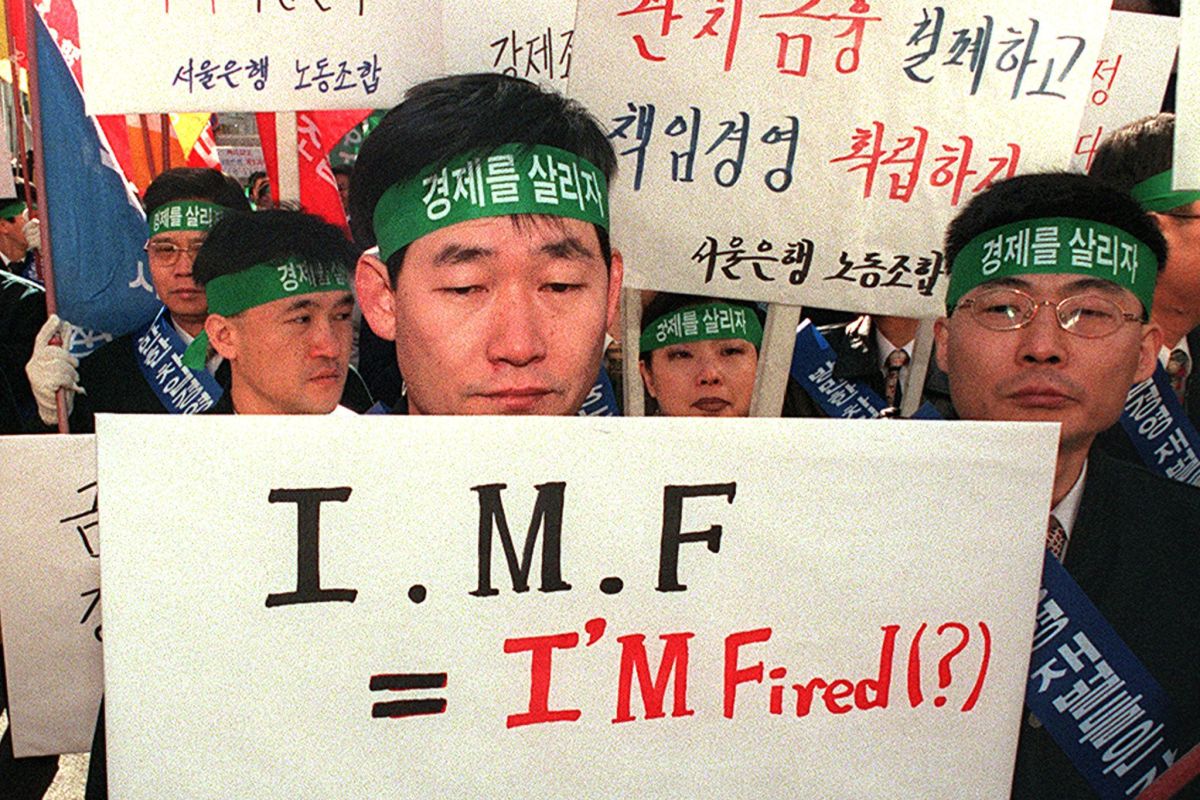
One thing I remember is that the acronym “IMF” in Korea was used in a different way.

IMF stands for International Monetary Fund.

But back then, many people said “IMF stood for I’M Fired”.

I was young when all of this began. Many of my classmates’ fathers were fired.

Some of them had decided to move to different regions, looking for a job and more affordable places to live.

As this all started in November, 1997, Koreans couldn’t celebrate Christmas that year. 

No one was playing Christmas carols.

No one decorated a Christmas tree, either.

People stopped sending Christmas cards.

Christmas and life as we knew it was never the same, following the IMF Crisis.

I don’t think it’s an exaggeration to say that the Financial Crisis was a traumatic event for a lot of Koreans.

Some changes were inevitable.

Many fathers lost their jobs…

They couldn’t pay their children’s tuition fee for the next semester.

So a lot of university students decided to join the military.  

And since private colleges and universities were more expensive than public schools, a number of students who took the Suneung exam in the year of 1997 wished to attend national universities, making the field more competitive.  

And a lot of international students had to return.

During the IMF crisis, the US dollar became more valuable compared to the won.

On December 23rd, in 1997, 1 dollar was converted into 2,067 won.  

Suppose that you are a Korean student who is studying in the states and that your parents are paying 2,000 US dollars in tuition fees.

Before the IMF crisis, your parents had to pay 2 million won.

But after the IMF crisis, those parents had to pay more than 4 million won… 

During the IMF crisis, we tried to make a big change.

For example, newspapers had fewer pages to save paper.

TV broadcasting stations ran for less time to save electricity.

Stores replaced imported products with domestic ones.

Public holidays were canceled.

Elevators were programmed to stop at every other floor to save energy.

Hospitals delayed non-emergency surgeries.

Companies encouraged their employees to turn in dollars or yen if their employees had extra.

Many people had experienced inconveniences, but did not complain.

Instead, many Koreans waited in line for hours and hours to donate their gold jewelry to pay down the country’s IMF debt.

Athletes gave up their medals and trophies.

Housewives donated their wedding rings.

Thanks to them, Korea was able to make a profit of over 300 kilos of gold.  

That way, we could overcome the financial crisis.

If you want to share your memories with me, please don’t hesitate to do so