Amidst the uncertainty of the COVID-19 pandemic, when so many of students’ opportunities to study abroad and conduct fieldwork were interrupted, I was lucky enough to successfully travel to South Korea twice. My first visit, in Fall 2020, I traveled as a study abroad student and was enrolled in Sungkyunkwan University. During that semester, I stayed in Seoul the entire time – I was too cautious to travel around the country and find myself contact-traced to a COVID case, or worse, become sick myself. However, during my second time in the country the following summer, I had more freedom, as during this visit, I was not travelling as an exchange student, but as a researcher.
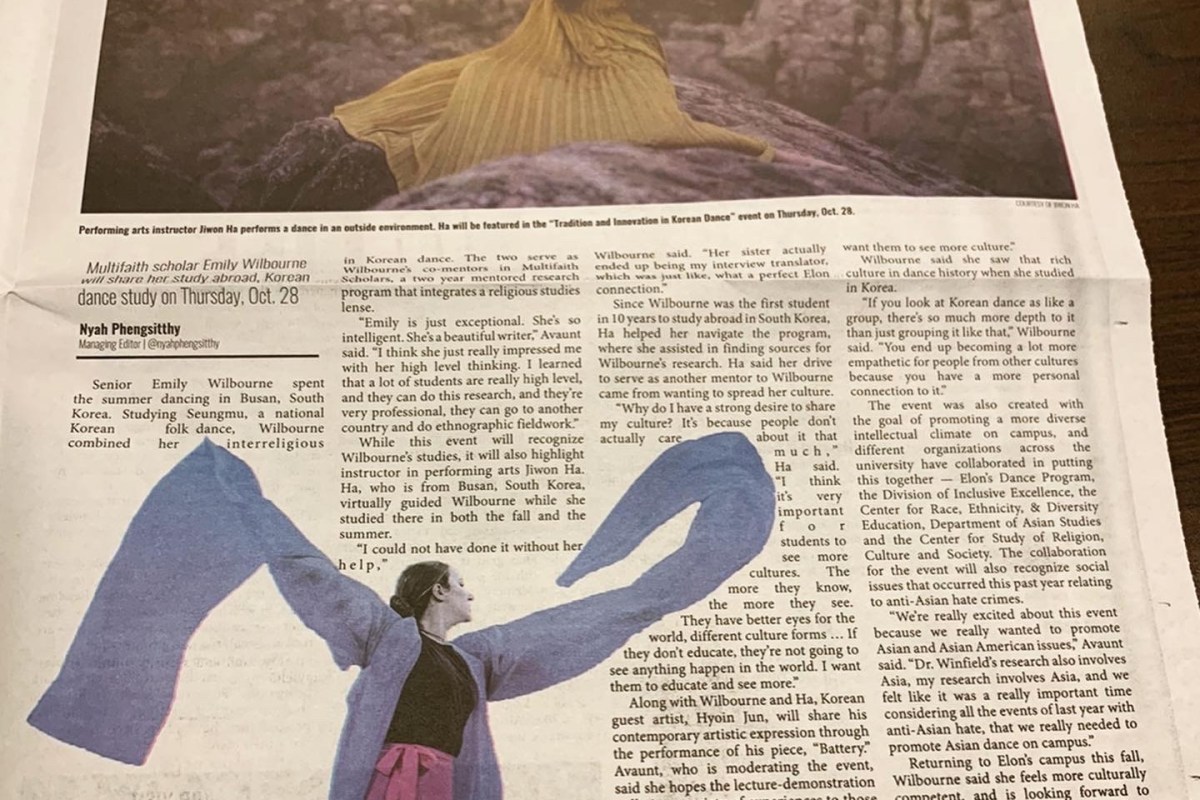
In summary, my undergraduate research was concerned with seungmu dance. This dance form, unique to Korea, has a history going back to as early as the 7th century, and was once performed exclusively by Buddhist monks. However, in the modern day it is a secularized intangible national treasure of Korea, that is preserved as a folk dance to represent Korean national identity. My research aimed to illuminate seungmu’s transition from religious to secular dance through a combination of historical research, interviews with seungmu performers, and participant observation in the dance form myself. To do this, I had to travel to Busan, South Korea. Factoring in quarantine time, my initial plan had been to work in Busan for six weeks, with my first two weeks spent in the mandatory quarantine that was in place for all travelers entering South Korea.
Though the focus of my trip was centered around completing interviews, making connections with seungmu dancers, taking dance classes, and recording field notes, I was greatly assisted by a professor of dance at my home university and a native of Busan, Jiwon Ha! She was able to assist me and recommend the best cultural sites to visit in and around the Busan area. In between doing my research work, I was able to visit several of them. Among these, my visits to the Haedong Yongungsa Temple, Busan Art Museum, Gamcheon Culture Village, and two performances at the Busan Gugak Center were the standout activities of my trip. Though slightly outside of Busan, our excursion to the Bulguksa Temple in Gyeonju was also a highlight.
As a scholar of Korean Buddhism, the opportunity to walk around both Haedong Yongungsa and Bulguksa were an amazing experience for me. Haedong Yongungsa, an oceanfront temple with sprawling cliffsides, multiple ornate buildings, elaborate pagodas, hiking paths up to beautiful ocean overlooks, and many stone and golden Buddha and boddhisattvha statues, was breathtaking. I found myself floored by the scale, beauty, and age of this well-maintained religious site. For both Buddhists and non-Buddhists, I think that the spirituality embedded in the Haedong Yongungsa campus shines through. I would consider this ocean temple a must-see location for any visitor to Busan. Even despite the oppressive heat of the Korean summer (I believe it was near 95 degrees fahrenheit/35 degrees celsius the day I visited!), I felt the hike around this site to be completely worth it.
At the time of my trip to Busan I was also majoring in arts administration in college, and so my visit to the Busan Museum of Art was a special experience. Featuring displays of contemporary art of a variety of mediums, I was impressed by the range of art on exhibition as well as the architecture of the building itself. It wasn’t a huge art collection but was clearly curated with care and thoughtful intention. Any lover of contemporary art would enjoy an afternoon walking around this museum.
The Busan Gugak Center features performances of traditional Korean music and dance regularly – including seungmu – which is one of the reasons I selected Busan as the city to focus my research and interviews in. The tickets for these performances were very affordable and I was able to see performances there on two separate evenings. Both times, the roster of performances showcased music and dance based in traditional Korean arts and featured a variety of stages from different Korean dance traditions. I was truly blown away by the scale, talent, and artistry that the production pulled off for these shows and was also pleased that, for both evenings, the audience was full of other people appreciating these preserved art forms.
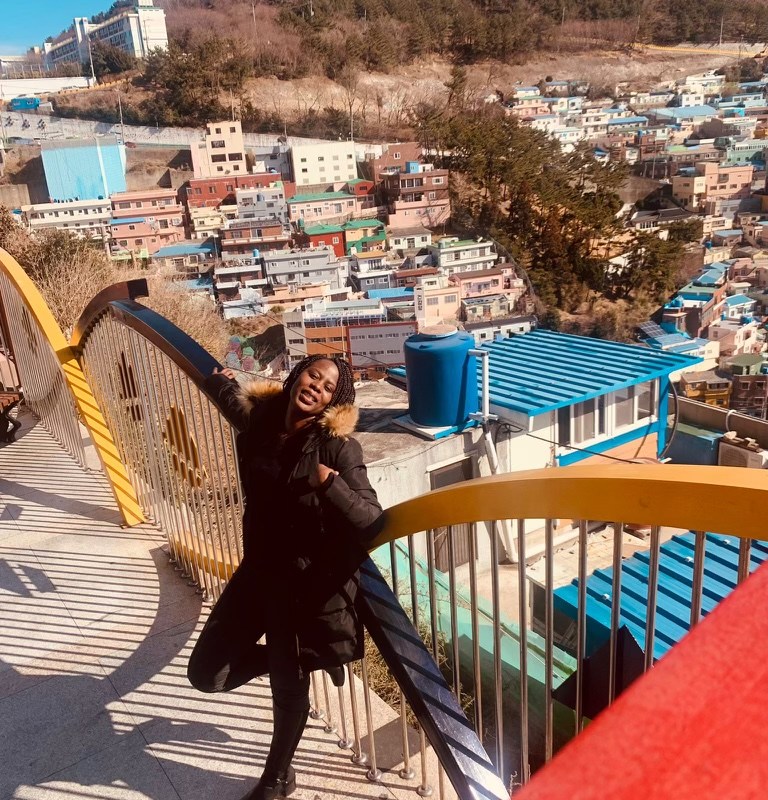
Individually, I also travelled to the Gamcheon Cultural Village, which delighted me. There is a helpful visitors center there, which features English-language pamphlets on the history and revitalization of the village. For someone who’s Korean is limited, the ability to walk comfortably through this colorful village at my own pace, without having to ask for help with navigation or pay anything to enter, was very welcome. However, in order to best appreciate the landscape, geography, and spectacle of the village, I do recommend that any traveler takes the time to buy a drink or snack from one of the many cafe’s that feature a rooftop patio and pauses to enjoy overlooking the vibrant landscape. I personally indulged in a much-needed slice of cheesecake after several hours walking around and the sense of peace I felt enjoying it while sitting on the rooftop patio of a small cafe and taking in the scale of the area is one of my fondest memories of all of my time in Korea.
For part of my trip, I was also staying in a hostel within walking distance from Haeundae Beach and enjoyed walking around the beachfront there each morning to exercise, relax, and start my day. Altogether, Busan was a beautiful place to visit. Between the mountains and oceans, temples and theatres, art and culture, and everything in between, it’s a city that has a lot to offer and I’m so grateful I had the opportunity to enjoy a small piece of it during my research travels.
On top of sightseeing, the main motivation for my visit, my research, was also a success and a publication of my final article is forthcoming this Fall! While my trip was unfortunately interrupted by several obstacles – extra quarantines, rainy weather, COVID-19 curfews and limitations – I think my experience proves that a memorable trip can still be made out of difficult situations. 








 Busan Travel & Living