Looking Forward to the BAMA 2022 International Hotel Art Fair

Who said that art has died? The art market is hot here in Korea! The annual art fair called “Art Busan” was held in Bexco last May. It was such a great success with a record of over 102,000 visitors and 76 billion won sales!

Thanks to the success of the BAMA Busan Art Fair, the Busan Gallery Association is coming back with the International Hotel Art Fair Busan BAMA 2022.

As the name suggests, the art fair uses luxury hotel rooms for its gallery.

The venue for the International Hotel Art Fair Busan will be the Grand Josun Busan Hotel. The fair will feature over 1,000 pieces of artwork.

The event will last from September 22nd to the 25th. Please note that the first day of the fair is for VIP guests only.

The entrance ticket costs 10,000 won and can be purchased in the lobby.

The interesting thing about this fair is that you can enjoy the beautiful art while viewing luxurious hotel rooms.

I highly recommend you check out the International Hotel Art Fair this month!

<Photos of the International Hotel Art Fair Busan 2021>

Aqua Palace Hotel [Hotel Review]

I love Gwangalli! I would sometimes hang out with my friends in Gwangalli, but I had never stayed in one of the hotels in the area.

During this visit, I wanted to watch the special Chuseok themed “Gwangalli M Drone Light Show,” so I made a last minute reservation. Luckily, I found an available room.

So, let me share a little bit about this place with you.

1. What is the Aqua Palace Hotel Like?

The Aqua Palace Hotel has a 3.5 star rating with around 110 rooms.

Surprisingly, there are no major brand hotels in Gwangalli. I think the Aqua Palace Hotel is one of the most popular hotels in the area.

The beach-front location is just unbeatable.

It is probably just me, but Gwangalli feels younger. It is always packed with young and stylish people. There are tons of restaurants, cafes, pubs and stores to check out.

The check in time is at 3 pm and the check-out is at 11 am.

2. What Are the Rooms Like?

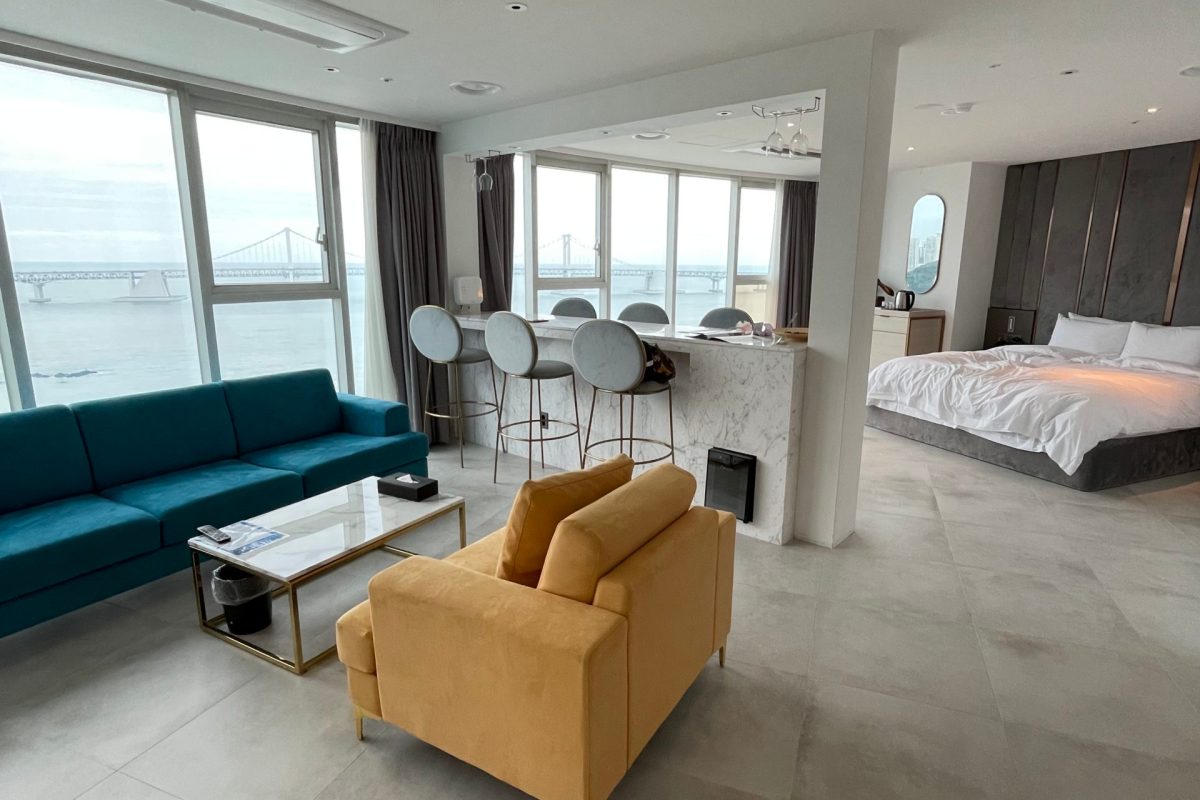
I stayed in the royal suite located on the 18th floor. The suite had a spacious living room, a dining area, two bedrooms and two bathrooms.

The hotel itself is old and outdated, but it looked like the room had been recently renovated.

The view was just the BEST. The floor to ceiling window presented a view of the whole Gwangalli Beach and Gwangan Bridge.

Trust me, the Drone Light Show happened right in front of my eyes.

3. What About the Hotel Facilities?

There is a spa, a water park, and an infinity pool.

However, the price of the room doesn’t come with access to the hotel facilities. According to their policy, even guests at the hotel must pay to use these facilities.

The spa and water park are open to non-guests while the infinity pool is for hotel guests only.

The lobby along with a bakery café is located on the first floor.

The hotel parking is very limited, so I recommend leaving your car at home.

4. What Else Can You do in the Area?

  • Beach – Take a walk by the beach when the weather is good.
  • Gwangalli M Drone Light Show – Don’t miss this FREE Drone Light Show which happens every Saturday.
  • Pub Hopping / Café Hopping – There are hundreds of cafes, restaurants and pubs to try.
  • Self Photo Studio – There are a few self photo studios in Gwangalli. You can simply take a photo and develop it for 4,000 won. There are wigs, sun glasses, hats and costumes to help you personalize your pictures.

5. How Can I get to Aqua Palace Hotel?

Use the subway. Gwangan Station (Busan Subway Line 2), Exit 3 or Exit 5

6. Conclusion

If you are looking for a hotel in the Gwangalli area with the best view, you should check out the Aqua Palace Hotel.

[This is NOT a sponsored post]

Beomeosa Temple

The leaves will soon begin changing their colors, so plan a hike before the beautiful leaves fall! I recommend checking out Beomeosa Temple [범어사].

1. General Information

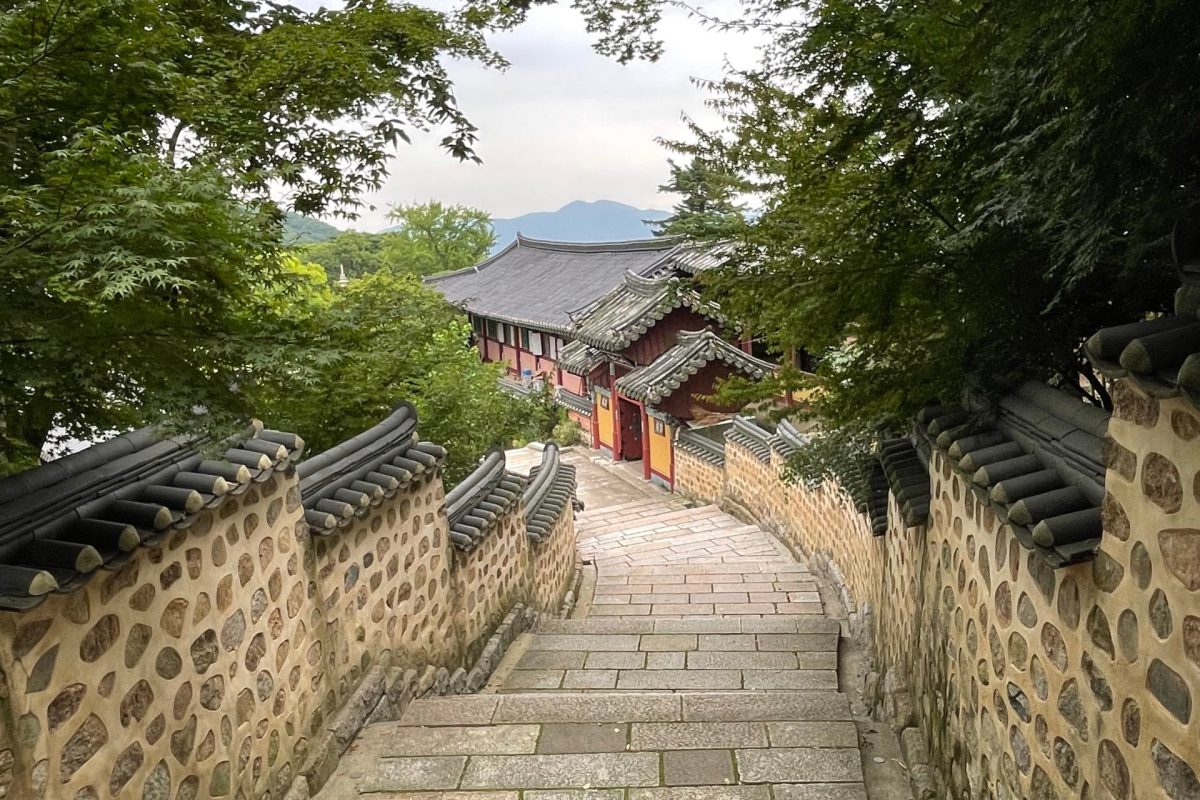
It is one of the biggest temples in Busan and the Kyoungsang Province regions. It has also been named one of Korea’s Great 5 Temples. Beomeosa written in a Chinese Character, that can be translated to “Shining fish.”

Location: It is located on the Geumjeong Mountain, which is one of the most famous mountains in Busan. This address is: 250, Beomeosa, Geumjeong-gu, Busan.

Open: Open all year round

Entrance: Free *You must pay a 3,000 won parking fee to park on the property.

2. The History of Beomeosa Temple

Beomeosa Temple was reportedly built in 678 by King Munmu of Silla Dynasty. However, the temple was destroyed in a fire in 1592 during the Japanese invasion of Korea during the Imjin War. It was later rebuilt in 1613 and is still standing to this day.

3. What to expect

Beomosa Temple has many beautiful walking trails where you can take memorable photos.

Beomeosa also offers many programs for visitors to attend in order to experience the culture. That includes “Temple-stay.” If you are interested, visit their website: http://www.beomeo.kr. Information on the website in available in either English or Korean. Make your reservation today!

When I visited, it was still about 30 degrees Celsius. Some people were even dipping their feet into the water next to the temple. This is a popular place to go hiking in the spring and autumn.

4. How to get here

Get off at Beomosa Subway Station. Near the Beomosa Subway Station, ride bus number 90. Bus number 90 comes every 20 minutes, and it goes all the way up to Beomeosa Temple.

Gwangalli M Drone Light Show (Line-up for September)

Gwangalli M Drone Light Show is a FREE attraction held twice every Saturday in front of Gwangalli Beach. Although the show happens weekly, Gwangalli Beach is packed with tourists, eager to watch the different light shows.  

This month features a variety of themes.  

September 3: Well-known characters from Poke Mon appeared in the sky.

September 10: To celebrate Chuseok Holiday, 1,000 drones will put on a Chuseok themed performance at 8:00 pm only.  

September 17: Famous landmarks will be showcased in the sky.

September 23 (Friday): There is usually no drone show on Friday, but to mark the opening of “2022 APP WORLD TOUR BUSAN SUP OPEN,” a drone show will be held at 8 pm with the related theme.

September 24: This drone show will also celebrate the “2022 APP WORLD TOUR BUSAN SUP OPEN,” but the show will differ from the previous day.

Photos taken by the Suyeong-gu District

When: Twice every Saturday

Drone show starting time: 8:00 pm & 10:00 pm (March – September)

                                              7:00 pm & 9:00 pm (October – February)

Location: Gwangalli Beach

How to get there: Gwangan Station (Busan Subway Line 2), Exit 3 or Exit 5

Tips: Parking is extremely difficult in the Gwangalli area, especially on the weekend. I highly recommend you use public transportation.

Huinnyeoul Cultural Village

The weather has been perfect recently. So this time let me introduce you to the “Huinnyeoul Culture Village (흰여울 문화마을),” located all the way in the Yeongdo-gu district!

General Information

Huinnyeoul Cultural Village is a cliff-side village located on the Yeongdo Island to the West of Busan.

Upon first glance, Huinnyeoul Cultural Village resembles the Greek village of Santorini, with its vintage and colorful buildings facing the ocean.

The History of Huinnyeoul Cultural Village

During the Korean War, thousands of refugees escaped and made the Huinnyeoul Cultural Village in Busan their home.

However, for a long time, this area was abandoned. It is said that the village didn’t even have a proper address until 2014, when the national address system changed and each street got its own name. The name of this area was randomly chosen to be “Huinnyeoul.”

By this time, many Korean movies and TV shows were being filmed in this area, some including “Nameless Gangster: Rules of Time,” “The Attorney,” “Infinity Challenge,” etc. This caused more tourists to flock to the area and more cafes and restaurants started popping up.

Taejongdae used to be ranked the best tourist spot in Yeongdo, but it has since been replaced by Huinnyeoul Cultural Village.

What to Do  

  • Try delicious food: my choice was ramen with this view. (yum!)
  • Visit film shoot locations: as I’ve mentioned, Huinnyeoul Cultural Village was featured in a number of popular K-movies and TV shows. Movie fans will love wandering the streets where their favorite characters once tread.
  • Shop in Huinnyeoul Cultural Village: there are many craft shops to explore.
  • Take memorable photos: this seaside tunnel is a very instagrammable location.

What to Expect

One thing to note about Huinnyeoul Cultural Village is that it’s built on a steep slope and will involve walking up lots of steps. So, I recommend you wear comfortable shoes. If you are traveling with a baby, I would advise leaving your stroller at home.

How to Get Here

If you drive a car, be aware that parking spots are pretty limited in Huinnyeoul Cultural Village.

There are some cafes that allow you to use their parking services for two hours. My recommendation is using one of these cafes for two hours after making a purchase. (I visited “Shingi-Yeoul 신기여울“).

Unfortunately, the subway doesn’t go to the Yeongdo-gu district, which means the bus transportation is pretty much the only means to get around.

Take the bus No 1006 at Bexco. Get off at “Huinnyeoul Cultural Village.”

[This is NOT a sponsored post]

Yeongdo Jonaegi Sweet Potato History Museum

It’s September already, and soon it will be starting to feel like autumn. There is a Korean expression that describes the season of autumn.

It is “Chun-go-ma-bi (천고마비)”. People say, “it is the time of Chun-go-ma-bi.” Have you heard this expression before, and can you guess its meaning?

Chun – Sky

Go – High

Ma – Horse

Bi – Fat

It literally translates to, “the sky is high while the horse gains weight.” Simply put, it means “autumn is a good season to go outside and eat!” Since autumn is the season of harvesting goods, there is a lot of good food to enjoy.

By the way, did you know that there is a sweet potato history museum in Busan? Well, there is! So let me tell you about the history of how sweet potatoes came to Busan.

Yeongdo Jonaegi Sweet Potato History Museum

It goes back to 1764 during the reign of King Yeongjo (영조) of the Korean Joseon Dynasty.

King Yeongjo

Joseon Tongsinsas were then diplomatic envoys sent to Japan at the request of Japanese officials.

This group was made up of diplomats, scholars, artists, and doctors. The group toured Japan – from Tsuhima Island all the way to Edo, which is today’s Tokyo. According to records, one group of Joseon Tongsinsa consisted of around 450 people, and they were all well-liked by their neighbors.

They were like the rock start we have today as they set international trends. Because of them, hundreds of horses, art pieces, stationery, books, and agriculture products were brought to Japan. In return, they we able to bring sweet potatoes from Japan.

Joseon Tongsinsa

During the 40th year of King Yeongjo’s rule, King Yeongjo sent a diplomatic mission to Japan. Jo Eum (조엄) was the chief envoy over the mission. According to reports, 477 people traveled with him. Jo eum soon found sweet potatoes in the northern parts of the Tsushima Island. He loved the taste of them and thought that if Joseon people could grow sweet potatoes in their backyard, they would not have to worry about having enough food to eat.

So, he had one of his officials named Lee Unghyuk (이응혁) carry a few sweet potato slips back with him. (Did you know that sweet potatoes do not have seeds like most other vegetables. Instead, they produce something called a slip, which can be planted like a seed!) However, Lee failed to keep the slips from rotting on his way back home.

Meanwhile, the Dongrae (동래) city official, Kang Pilly (강필리) found out that Jo had discovered

sweet potatoes in the northern parts of the Tsushima Island and that the sweet potato slips carried by Lee could not be replanted. He could not wait to grow and enjoy his own sweet potatoes. He had people go and retrieve more slips from Tsushima Island. This time the slips made it back to Busan without any issues.

The first sweet potatoes were planted in the Yeongdo-gu district of Busan in the spring of 1765 in the Naegi area. To remember Jo’s effort in bringing sweet potatoes to Korea, Kang decided to put his last name “Jo” before “Naegi.” That is how the sweet potatoes were named “Jonaegi sweet potatoes.” People believed that sweet potatoes grown in that area tasted the best. That’s why Jonaegi sweet potatoes are still the most popular sweet potatoes in supermarkets in Korea.

Meanwhile, the Dongrae city official named Kang spent a lot of time researching sweet potatoes.

He even published his research in a book. The title of the book was “Gamjeobo (감저보).” Sweet potatoes are now called Goguma (고구마), but back then, they used to be called Gamjeo (감저). Interestingly, potatoes are called Gamja in Korean. So, when sweet potatoes were first brought to Korea, people probably named the sweet potatoes Gamjeo by changing one vowel in the word Gamja.

Anyways, thanks to Kang’s book, people from different regions have started to grow sweet potatoes.

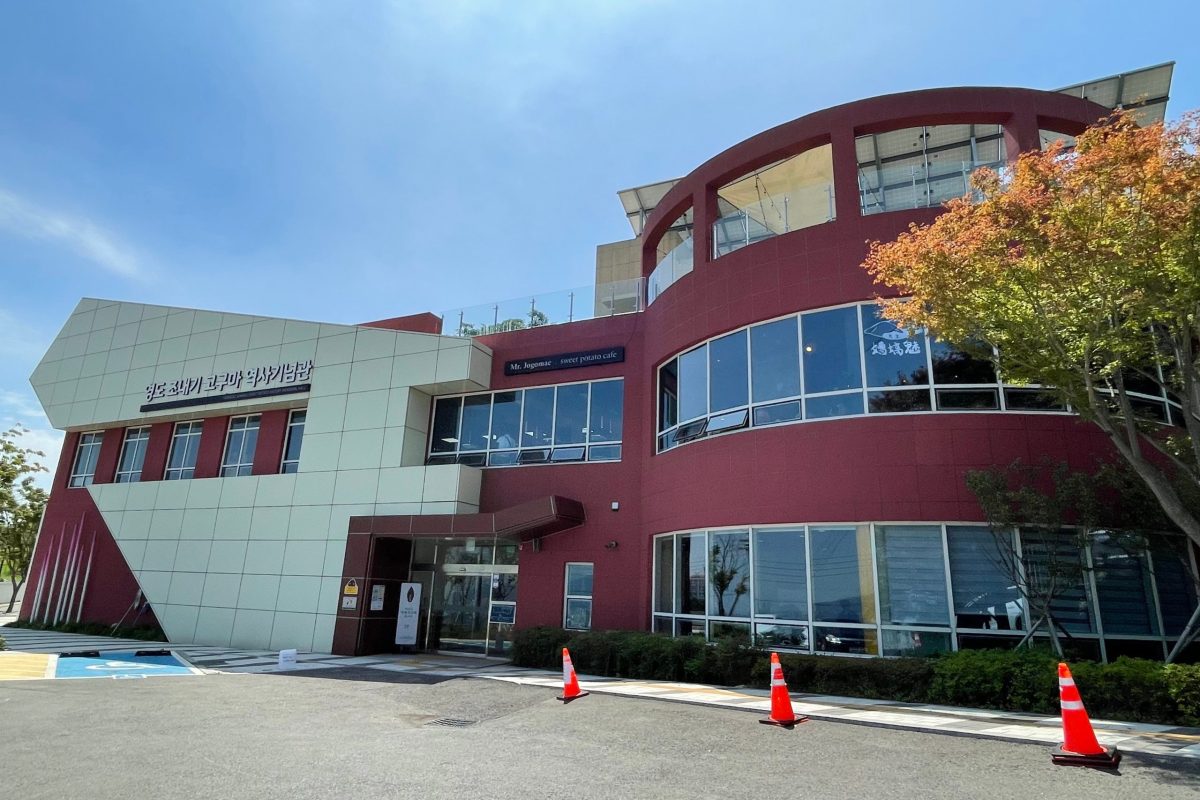
So check out the Jonaegi Sweet Potato History Museum located in Yeongdo to find more information. There is also a café that serves sweet potato inspired drinks and baked goods. My favorite is the homemade soy milk served in a kettle! Twice a month, a cooking class is held for kids to join.

Address: Cherry Blossom Road 75, Yeongdo-gu, Busan

Hours: 10 am to 6 pm (Closed on Mondays and national holidays)

Admission: Free

How to get there: Take bus 101 at Busan Train Station. Get off at Yeongdo Bridge. Transfer to village bus number 7 at 청학 [Cheonghak] gas station and then get off at 동조 Dongjo Regency. (You will climb one of the steepest hills on your way to the museum! )

Busan Biennale 2022

Busan Biennale 2022 is a biannual international contemporary art show. They will kick off their new season on September 3rd with the theme, “We, on the Rising Wave.”

The former deputy director of Art Sunjae Center, Haeju Kim oversaw this year’s Busan Biennale as artistic director.

While making a press statement, Kim said, “the biennale will look into how Busan has been formed as it is today, after going through modernization, liberation from Japanese colonial rule and industrialization.”

64 artists from 26 countries will have their art on display in the show this year. The 2022 venue is the Museum of Contemporary Art (MOCA) in Busan. The museum is located on Eulsukdo Island in the western part of the city. The Busan Biennale 2022 will last for 65 days, concluding on November 6th.

Photo taken by Yonhap News

Haedong Yonggung Temple

The summer is truly flying by! At first, it felt like summer would never end, but here we are getting ready to start the month of September and back to school season. The good news is that autumn is a great season for a variety of outdoor activities. So, my recommendation for today is that you check out the Haedong Yonggung Temple [해동용궁사]!

General Information

If I directly translate Haedong Yonggung Temple, it would be “Ocean Dragon Palace Temple.” This name suits the temple very nicely. The vibe at Haedong Yonggung Temple differs from any other temple. While most are located in the mountains, Haedong Yonggung is positioned right next to the ocean. This is one of the many reasons why Haedong Yonggung Temple is always flooded with people.

Location: Yonggung-gil (Yonggung Rd) 86, Gijang

Open: From 5 am until sunset (6:30ish)

Admission: It is free to enter the temple, but you must pay to park your car.

The prices for parking are as follows: 2,000 won (first 30 mins), 500 won (per extra 10 mins) and 20,000 won (daily maximum)

The History of Haedong Yonggung Temple

It is believed to have been first built in 1376 by King Gongmin. It was later destroyed during a Japanese invasion in 1952. The temple was then rebuilt in 1930 by Monk Un-Kang of the Tongdo Temple. In 1974, the Haedong Yonggung Temple was named by a monk named Jeongam. It is said that Jeongam chose the name after he dreamed of a flying dragon.

What to expect

On the way to the temple, you will pass several cafes, souvenir shops, and 12 different stone zodiac statues. Many people take pictures next to their zodiac animals there.

After entering, you will walk down 108 stairs. This number refers to spiritual completion in Buddhism.

The statue is called “득남불.” Many believe that this statue is able to help those who have had a hard time conceiving. The three little statues are called “학업성취불” and they are supposed to help students pass an exam.

Many people toss coins over the bridge at the entrance as a way of bringing them good luck. The bridge is also a great place to take a quick picture. Nearby, there is a beautiful bamboo forest that brings a relaxing feeling to the area.

The statue is called “굴법당. This stone statue is 10 meters tall and is said to be the biggest stone statue in Korea.

How to get here

From Bexco, you can take the bus No. 181 or 1001 and get off at the Yonggung Temple/ National Maritime Science Center Stop.

What else can you do?

*Lotte Premium Outlet Dong-Busan sells many big names for an affordable price.

*Skyline Luge People of all ages can enjoy the activities here!

*Gijang Children’s Museum If you travel with kids, check out the Gijang Children’s Museum. There are so many different things that your kids can explore while visiting.

*Ananti Hilton Busan This is a 5-star hotel located very close to the temple. Even if you don’t stay here, there is a small town on the hotel property where you can shop and dine.

The History of Jeombachi Alley

Today, I would like to tell you about a small town in Busan that used to be bustling with fortune tellers.

Btw, have you ever been to see a fortune teller? My friends and I visited one once in our early 20s after graduating from university and starting our first jobs.

You know… everyone worries about something while in their 20s… My friends and I were no exception. We were worried about our futures and felt that we needed guidance on some of the more important choices we would have to make.

So, another one of my friends told us about an older lady who was the best fortune-teller in Busan.

More than ten years have passed since my last visit and believe it or not, most of her predictions were fairly accurate. The fortune-teller said that I would have many chances to speak in front of large crowds, which is true now that I have worked for a radio station. I don’t know if everything happened by coincidence but visiting a fortune teller was not as bad as I thought it would be.

Let me get back on topic…

There used be a town in Busan filled with fortune tellers.

The town was located under the Yeongdo Bridge and used to be called “점바치 골목 or Jeombachi Alley.”

Any ideas what Jeombachi (점바치) means?

Korean for “a fortune teller” is 점쟁이 [Jeom-jang-ee]. People in Busan speak with a Busan dialect. Speaking with a Busan dialect, “점쟁이” was “Jeombachi”. (But personally, I’ve never heard anybody say “Jeombachi”.)

Do you know what the Yeongdo Bridge meant to Koreans during the Korean War?

Busan was one of the only cities not captured during the Korean War, so millions of refugees gathered here for safety. Back then, the Yeongdo Bridge was a very important place, because it was where many refugees promised to reunite with their loved ones.

So, why do you think people visit fortune tellers?

People visit fortune tellers for many reasons, but most commonly because they need guidance through a dilemma.

After the Korean War ended, people struggled to survive. They were faced with the uncertainty of the future. So they visited Jeombachi Alley.

The fortune tellers there provided them with a peace of mind. Then, by having their futures predicted via their star, palm, Saju (사주), or by cards, it gave them a sense of security.

Back in the 1950s and 1960s, there were more than 50 fortune teller shops in “Jeombachi Alley”.

When refugees visited a fortune teller, they asked things like, “where and when can I find my sister, Mija?” or “Should I continue living in Busan?”

But now, Jeombachi Alley doesn’t exist anymore.

So why are there very few fortune tellers left?

Some fortune tellers have died of old age or have been asked to stop their practice.

Due to a redevelopment plan, the remaining fortune tellers, who had spent 40 to 50 years of their lives under the bridge, were asked to move out. It was in 2013 when the last fortune teller left the area.

Instead, new cafes, bakeries and restaurants have been built in their absence.

But many people raised their voices in support of Jeombachi Alley, because it’s intangible cultural heritage.

The City of Busan planned to move “Jeombachi Alley” to Eurari (유라리) Square, a small square located next to the Lotte Department Store in Gwangbok-dong.

So, in 2016, the government called upon a few fortune tellers who were interested in starting a fortune-telling business in Eurari Square, but some vendors who already worked at the square protested these plans. They did not want to share the space with the fortune tellers.

In the end, Jeombachi Alley simply disappeared.

La Valse Hotel [Hotel Review]

Are you planning on taking a trip to Busan with your friends, partner or just alone? If so, I recommend checking out the stylish but affordable ‘La Valse Hotel’.

1. What is the La Valse Hotel Like?

The La Valse Hotel is a 4 star hotel located in the Yeongdo-gu district, Busan.

Yeongdo has played an important role in Busan’s historical and economical growth.

But Yeongdo has not yet been fully developed. So here in Yeongdo, you can still see a little bit of Busan’s original appearance.

The check in time is 3:00 pm and the check out is at 11 am.

It feels like La Valse is perfect for young couples and business travelers alike.

2. What are the Rooms Like?

I stayed in the ‘Standard Ocean View Twin Bed Room’ with my husband and two kids.

While the rooms with a view of Busan Bridge (aka Ocean Corner View) are most preferred, mine didn’t have one, but I didn’t mind.

I had another issue, which was the size of the room. More specifically, the size of the room was okay, but the size of each bed was the problem. Two of the beds that were supposed to be shared by four people were way too small. Sleeping next to my little girl (who is only three), I couldn’t help tossing and turning around all night, because of the lack of space.

I’d seen some guests with families, but it felt like this hotel seemed more suitable for young couples and friends on vacation. 

3. What About the Hotel Facilities?

There’s a convenient store, café, and reception desk all located on the first floor. A fitness center and laundry room are located on the 4th floor. There is another café on the 28th floor, which offers you complimentary breakfast. You can always check out the beautiful view from the rooftop while eating your food.

4. What Else can You do in the Area?

*Gukje Market: It used to be one of the biggest street markets in Busan back in the day. It was formed after the Korean War when refugees who fled to Busan began selling imported goods for non-Korean military members. Many Korean movies have been filmed in Gukje Market.

*Taejongdae: Located at the end of Yeongdo Island is a beautiful hiking path. ‘Pachinko’, a drama TV series on Apple TV also featured scenes filmed on Taejongdae.

*Jagalchi Market: It’s an old fish market. From raw fish to dried fish, they’ve got it all. Even if you are not a big fan of fish, this place is unique for tourists.

*Gwangbok Lotte Department Store: Just crossing the Busan Bridge, you can check out the Gwangbok Lotte Department. So handy!

*Kkangkkangee Art Village [깡깡이 예술 마을]: Did you know that Korea makes the most ships worldwide? Indeed! The shipbuilding industry began here at Yeongdo. They run a special tour program every weekend so you should take a look and experience it here at Kkangkkangee Art Village.

5. How Can I Get to the La Valse Hotel?

The La Valse Hotel is only 3 kilometers away from the Busan Train Station. So close! If you take a taxi from there, you can get to the hotel in about 10 mins. This might cost between 5,000 won – 7,000 won.

Or if you take the subway, get off at the Nampo Subway Station. Here you will find the hotel is in 10-15 mins walk.

6. Conclusion

Whether you are a solo traveler or a couple looking to adventure in Busan, the La Valse Hotel can accommodate all of your instagrammable moments and history lessons all for affordable price.

[This is NOT a sponsored post]