Asking Someone’s Age

In Korea, people often ask other’s their age. This is because age often determines whether someone should speak formally or casually to another person. Age also determines how we call each other, labeling the person “oppa,” “unnie,” “noona” and others.

So today let’s learn some expressions about age.

1. 나이가 어떻게 되세요?

If you translate it word for word, it means “How is your age?”

If you ask this question to someone who is obviously way older than you, you can ask “연세가 어떻게 되세요?” “연세” is the formal Korean word to describe “age.”

2. 혹시

This is a very good expression to remember. It means “if you don’t mind me asking.” If you say “혹시” before what you ask, you may sound a little more polite. For example, “혹시, 나이가 어떻게 되세요?” means “if you don’t mind me asking, how old are you?”
3. 무슨 띠세요?

It literally means, “What’s your zodiac sign?” Your zodiac animal is determined based on the year you were born. So people sometimes ask someone’s zodiac sign to figure out how old the person is.

4. 빠른 90이에요.

These days, kids born in the same year are in the same grade at school. But back then, kids born from March to the next February were in the same grade. So, kids born in January and February sometimes experienced an awkward situation where their “friends (those born in the same year)” were one grade lower and considered a “junior.”

So, people often use the expression, “I was born early that year.” It is a very cultural expression, right?

5. 5학년 1반 입니다~

It literally translates to “I am in fifth grade in class 1.”

But it means “I am 51 years old.”

This is not a common expression but I have seen some elderly people using it. When people feel shy about sharing their age, they may use this indirect way to describe how old they are.

Idioms to Learn from the Drama Series “Crash Course in Romance”

The K-drama, titled “Crash Course in Romance” was a big success. To make a long story short, it was about an unlikely love story between the mother figure of the student, Jeon Doyeon and the star teacher Jeong Kyoungho, aka 일타강사.

Why not learn some idioms related to this? Maybe it can give you a little bit of an insight into Korean culture. 

일타강사 : 일타 – It is a compound word with “일” meaning number one, “타” which is tar from star, and “강사” stands for a teacher or a lecturer.

While Korean education is generally very competitive, the area, called “Daechi-dong” has a mecca of private academies. The whole strip is packed with building after building of private education facilities. Every evening, traffic is unbelievable as moms pick up their kids from hagwons (cram schools).

Even among many hagwons in the Daechi-dong area, there are some star teachers. They are called 일타강사 and some of them are known to make 10 billion won (approximately USD 8 million) a year.

쪽집게 강사 / 쪽집게 과외: tweezer teacher / tweezer tutor

Some hagwon teachers and tutors are labeled as “tweezer teachers” or “tweezer tutors.”

As you can probably guess by the name, they are like tweezers when picking the right exam material for their students to study.

Of course, those “tweezer teachers” are on high demand.

대치 키즈: Daechi-Kids (or Daechi-dong Kids)

As the Daechi-dong in Seoul is considered the best area to receive private education, many moms are eager to move to there before their kids enter elementary school. The kids who grew up in Daechi-dong are labeled “Daechi Kids.”

Anyways, if you haven’t watched “Crash Course in Romance,” I highly recommend it!

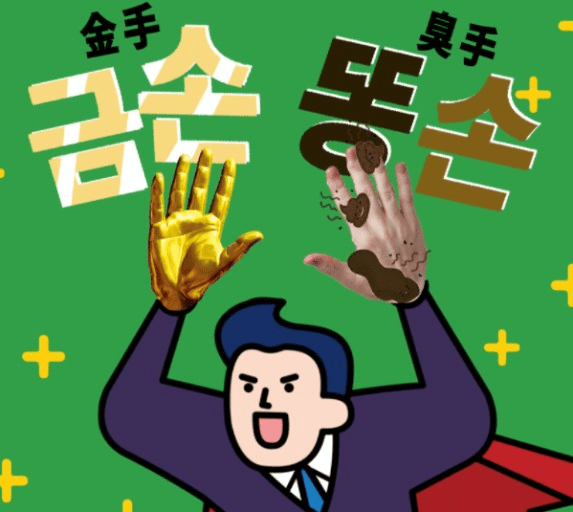
똥손 / 금손

These days, a lot of make-up and hair tutorials are available on YouTube and Instagram. For some, no matter how hard they try, the outcome is far from what they see online. In this case, there is an idiom we often use, “나 똥손이에요,” which roughly translates to, “I have pooh hands.”

On the other hand, if you are good at following online tutorials (makeup, hair, calligraphy, etc.), we would use the idiom, “금손이다,” which means “gold hands.”

Korean Idiom: 액땜 / 액땜하다

Happy New Year! The new year has officially begun.  I hope 2023 will be extraordinary for everyone!

Since we just started the new year, I think now is the perfect time to introduce you to this Korean idiom, “액땜.”

This idiom can be used if a bad thing happens especially before the start of something new, like the beginning of a new year, a semester, or vacation.

액땜 means, “If you are experiencing something bad now, you are lucky because that bad thing will prevent something worse from happening in the future.”

For example, if you lost your wallet before you went on a trip and you had to replace your driver’s license and credit card. Then people around you might say, “액땜했어,” meaning, “the bad luck you just had will prevent something from going wrong while you travel.”

In the word “액땜하다,” “the bad thing” is considered a “vaccination.”

I wonder if your culture has a similar expression. If so, leave a comment below!

Interesting Idioms Describing Moms and Dads

1. 주말부부 (Weekend married couple) 

주말 means weekend while 부부 stands for a married couple. 

Can you guess what “weekend married couple” means? As you might have guessed, this phrase refers to a married couple who get to see each other only on the weekends. This may happen if the couple works in two different cities, or if a mother wants to raise her kids where there are better schools.
This term can also be used as a verb. For example, you could say, “나 어릴 때 우리 부모님은 주말부부 하셨어,” meaning, “when I was little, my parents 주말부부ed.”

2. 기러기 아빠 (Wild goose father) 

기러기 is wild geese while 아빠 is dad. “Wild goose dad” means a dad who is supporting his family while they live abroad.

Families sometimes send their kids overseas to English speaking countries so that they can get more opportunities and different education. Sometimes moms go with their kids to take care of them while the dads stay in Korea to support them. Unfortunately, this might lead to family issues and even social problems. 

So, “기러기 아빠” or “wild goose dad” is often used in newspapers, too. 

3. 엄빠 (Umpa = Umma + Papa) 

These days GenZs shorten every word possible, and “엄빠” is just one of them. 엄 refers to 엄마 (Mom) and obviously 빠 is from the word 아빠. 

So, when put together, it means “mama and papa.” Young people tend to casually use this word instead of “부모님 (parents).”

4. 맹자 엄마 (Mencius’s mom) 

Mencius is one of the greatest Confucian philosophers in China. It has been said that his mother moved over 3,000 times to find him the best education possible. 

So, moms who are super enthusiastic about their kids’ education are called as “Mencius’s Mom.”

Useful Expressions to Remember When Driving in Korea (Part 2)

1. 주차할 곳이 없어서 이중주차를 했어요 (I had trouble finding a parking space, so I double-parked my car.)

This sometimes happens when the parking lot is full.

Unfortunately, those who live in old apartment complexes or villas that don’t have large parking lots deal with this problem every day.

When a person fails to find a parking space, they sometimes end up parking in front of someone’s car. In this case, we use the expression, “이중주차” meaning “double-parking.”

2. 중립으로 해뒀어요. (I left my car in neutral.)

When someone double-parks their car, they usually leave it in neutral. This allows someone to push the car out of the way, if they were blocked in. In this case, you can use this expression.

3. 견인되었어요. (My car has been towed.)

There is a higher chance that your car will be towed if it is not parked in the proper parking lot. I hope that you don’t find yourself needing to use this expression.

Useful Expressions to Remember When Driving in Korea (Part 1)

1. 길치에요 (I have a bad sense of direction.)

Something-치” means that you are bad at it.

For example, if you introduce yourself as “음 (tone) 치,” you are saying that you are tone deaf.

If you say that you are “몸 (body) 치,” that means that you are not good at dancing.

길 means way or direction, so “길치에요” means that someone has a bad sense of direction.

2. 타이어에 펑크가 났어요. (I have a flat tire.)

This can be literally translated to, “my tire has a punk.” This phrase is an example of Koreans using Konglish.

3. 문콕 (문: door/ 콕: “kok” the sound of clashing)

I admit, the parking spaces in Korea are not very large. You should be extra careful when opening your car door, so you don’t accidentally hit the car parked next to you. An “accident” like this is called “문콕.” I hope you never find yourself in this kind of situation.

Korean Idiom: 돌싱

Season three of the Korean reality TV show titled, “Divorced Single” was a great success.

The show was so popular and quickly became the talk of the town.

Its Korean title is “돌싱글즈.” So, let’s learn an idiom that relates to the show.

돌싱” is an abbreviation for “”아온 ”글.

돌아온 means “coming back” or “returning,” while 싱글 means single.

When put together, these words can refer to someone who is newly single after getting a divorce.

Four Work Related Korean Idioms

Here are four interesting job-related Korean idioms!

1. 취준생

I’ve said this before, but Koreans use abbreviations in many situations. “취준생” is also one of them!

취 refers to 취업 (finding a job).

준 refers to 준비 (preparing)

생 is the last word of 학생 (student).

When you put them together, it means, “I am a student (person) preparing to find a job.”

People use this idiom when they are in-between jobs.

2. 철밥통

철 is steel while 밥통 means a rice-cooker (or a rice-bowl).

The literal meaning is a rice bowl made from steel.

This idiom is often used to describe those who work in public sectors because the chances of them getting fired is slim.

Being a civil servant is a stable, but competitive field here in Korea.

3. 목구멍이 포도청

목구멍 is a throat, and 포도청 is an old word used to describe a police bureau.

Putting food on the table is very important, which forces many people to continue to work jobs that they do not enjoy doing. This idiom could be used to describe someone in this situation.

4. 직업병

Can literally be translated “job-sickness” or “job-disease.”

This can be used both positively (humorously) and negatively.

For example, let’s suppose that you are an office worker who has developed pain in your wrists from typing at a computer all day. In this case, you can say, “the pain in my wrist is a job-disease.”

Meanwhile, the personality you develop after working a certain job can also be called “직업병” (job disease or job-sickness).

For example, my mother was a teacher for 20 years and sometimes when she talks, she still sounds like she is lecturing a class. That’s her “직업병.”

What about this? Let’s suppose that you are a TV personality. One day, you are having a family gathering and even though no one expects you to entertain the group, you still feel it is your responsibility to do so.

This “personality” developed after working in a certain field for a long time is also called ”직업병”.

4 Idioms Related to Money

Money is something that we spend every day, so we have developed many expressions and idioms to use when talking about money.

1. 내 월급이 쥐꼬리만 해요

It can be roughly translated to: my paycheck is as small as rat’s tail. This could mean that someone is living paycheck to paycheck. We often hear angry wives say, “how am I supposed to save money if my husband’s paycheck is as small as rat’s tail?”

2. 돈에도 눈이 있다

It literally means, “money has eyes.” You could use this idiom in a situation where you had to spend the extra money that you had earned that month on something unexpected.

3. 재테크

This idiom is commonly used across Korea since everybody these days is interested in growing their money via gaining interest on savings accounts, selling real-estate, investing in stocks, selling gold, etc. ‘재’ is ‘re-‘, and 테크 is ‘tech’. This is a Chinese character/English combined word. Simply put, 재테크 refers to a certain kind of skill to be able to successfully grow your money.

4. 돈 방석에 앉다

This literally means, “someone is sitting on a money cushion.” We use this idiom to describe someone who is very rich and successful.”

[This is NOT a sponsored post]